

Your Content Is Already an AI Asset: Turning Content into Knowledge

We are drowning in information but starved for knowledge. — John Naisbitt
We Have the Information. So Why Can’t We Find It?
You know that moment when you are sure a document exists somewhere—but you have absolutely no idea where?
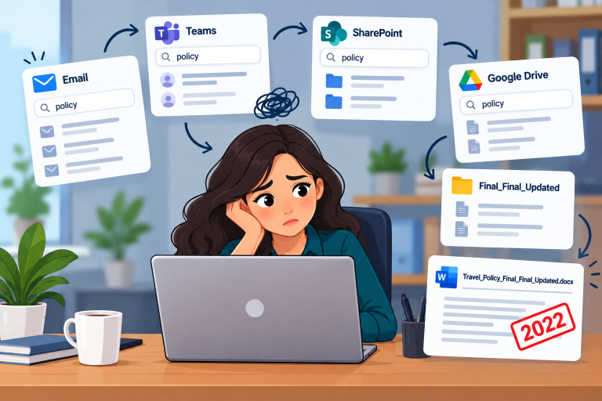
You search your email. Then Teams. Then SharePoint. Then Google Drive. Then that folder someone created three years ago called “Final_Final_Updated.” And just when you think you’ve found the answer, you discover that the document is from 2022.
Sound familiar? This happens in almost every organization.
Companies have spent years creating and collecting information:
- Policies and procedures
- Product manuals
- Training material
- Research reports
- FAQs
- Presentations
- Websites
- Customer information
- Internal knowledge bases
Most of it is digital. And yet, finding the right piece of information at the right time can still be surprisingly difficult. The information is there. The problem is getting to the knowledge inside it.
Imagine an employee asks:
“How many days of unused leave can I carry forward?”
The answer probably exists in an HR policy. But the employee doesn’t want to read a 60-page document. They want the answer.
Or imagine a service engineer standing next to a machine that isn’t working properly. The information needed to fix it may already exist in a service manual, technical bulletin and troubleshooting guide—but in three different places.
A researcher may know that the answer to a question is somewhere in the organization’s archive but has to go through dozens of reports to find two useful paragraphs.
The organization doesn’t necessarily lack information. It lacks easy access to the knowledge hidden inside that information. And this is where AI starts to change things. Instead of asking people to remember where something is stored, AI can allow them to ask what they want to know:
“What is the current process for international travel?”
“Which modules should I revise before taking the assessment?”
“What should I check if this machine shows error code X?”
That’s a very different way of interacting with information.
But there is a catch.
AI can only be as useful as the information behind it.
Giving an AI system access to thousands of documents doesn’t automatically turn those documents into useful knowledge. So, the AI journey doesn’t really start with the chatbot, the AI model, RAG or AI agents.
It starts with the content an organization already has—and what it does with that content.
So, How Does Content Become Knowledge?
If content is simply information, how does it turn into something that people and AI can put to use?
It happens when we give information structure, context, relationships and rules.
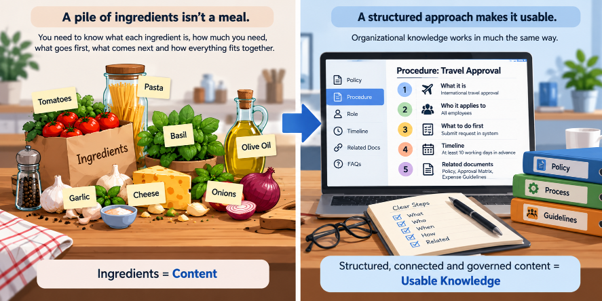
Think about a recipe. A pile of ingredients isn’t a meal. You need to know what each ingredient is, how much you need, what goes first, what comes next and how everything fits together. Organizational knowledge works in much the same way.
The ingredients are the content.
The recipe makes that content usable.
Imagine a technical manual contains this sentence:
“Calibration should be performed after replacing the sensor.”
This is useful information but there are still questions.
- Which product?
- Which sensor?
- Is calibration always required?
- Is there a safety step?
- What happens next?
Now, let us give that information some structure:
Product: X200 Controller
Component: Temperature Sensor
Procedure: Sensor Replacement
Related Procedure: Calibration
Safety Requirement: Disconnect power
Next Step: Perform calibration
Suddenly, the information takes meaning. This is the transformation from content to knowledge.
Four things make the difference
- Structure — What is this?
A document can be broken into meaningful elements.
Product → Component → Procedure → Step → Warning
A course can become:
Course → Module → Lesson → Objective → Assessment
A policy can become:
Policy → Rule → Process → Role → Approval
Structure tells us what each piece of information actually represents.
- Context — What does it mean here?
Consider:
“Submit expenses within 30 days.”
Thirty days from when? For which expenses? Does it apply to everyone? Which policy version is relevant?
Metadata provides this context—for example, region, audience, document type, status, effective date and version.
- Relationships — What is it connected to?
Knowledge rarely exists in isolation.
A product connects to its components. Components connect to procedures. Procedures connect to safety instructions and training.
A certification might connect to a learning path, courses, modules, assessments, skills and job roles.
Capturing these relationships allows a system to understand how pieces of information fit together, rather than simply finding matching words.
- Governance — Can we trust it?
Information also needs ownership, version control, approval status, review dates and access permissions.
Imagine there are three versions of a travel policy. If nobody has clearly identified the current approved version, an AI system can find all three—but may not know which one to use.
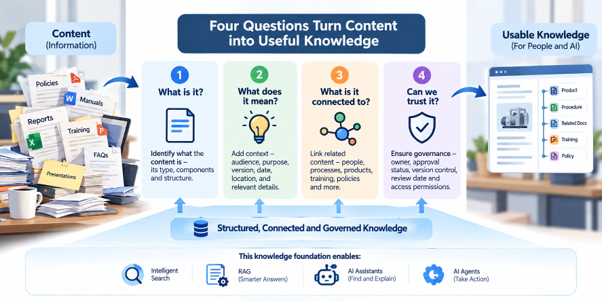
So, content becomes useful knowledge when we can answer four questions:
What is it?
What does it mean?
What is it connected to?
Can we trust it?
That is the foundation on which intelligent search, RAG, AI assistants and agents can work.
Digitization Is Only the Beginning
There is another reason that this matters. A lot of organizational knowledge has already been digitized. But digitized doesn’t necessarily mean usable.
Take a technical manual.
A person looking at the original document can see the heading, warning box, diagram, table, procedure and cross-reference. When that document is converted into plain text, much of that meaning can disappear.
You may still have:
“Calibration should be performed after replacing the sensor.”
But the system may no longer know which product, component, warning or procedure that sentence belongs to.
The words survived. The relationships may not have.
This is why simply scanning documents, converting them to PDFs or extracting their text isn’t enough. The goal is not merely to make information digital.
It is to make it understandable, connected and reusable. And that distinction becomes especially important when AI enters the picture.
From Knowledge to AI: Where Does RAG Fit?
Once an organization has built a structured and governed knowledge base, the next question is:
How does AI use it?
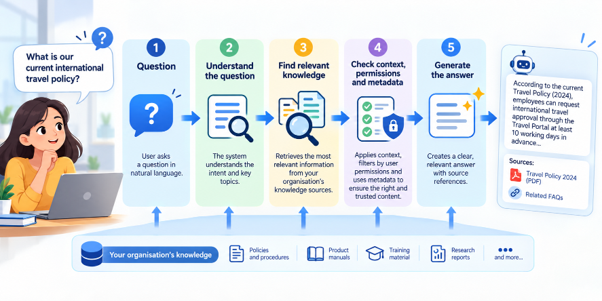
This is where Retrieval-Augmented Generation, or RAG, comes in. In simple terms, RAG allows an AI system to retrieve relevant information from an organization’s own knowledge sources before generating an answer.
The process looks something like this:
Question
↓
Understand the question
↓
Find relevant knowledge
↓
Check context, permissions and metadata
↓
Generate the answer
So, if an employee asks:
“What is our current international travel policy?”
the system can retrieve the relevant organizational knowledge rather than relying only on the AI model’s general knowledge. That’s the important distinction. RAG is not the knowledge itself.
It is the bridge between the knowledge an organization has built and the AI experience users interact with.
But RAG cannot decide everything on its own.
If information is incomplete, conflicting or poorly governed, the system still needs organizational rules to determine what should be trusted.
That is why good AI experiences depend on good knowledge foundations.
One Knowledge Base, Many Possibilities
Once content is structured, connected and governed, something interesting happens.
The same knowledge can be used in many different ways.
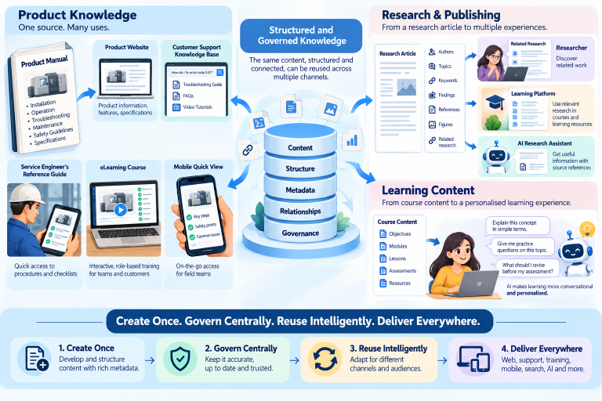
Consider a product manual.
The same underlying knowledge could support:
- A product website
- A customer support knowledge base
- A service engineer’s reference guide
- An eLearning course
- A mobile quick-reference tool
- Internal search
- An AI assistant
The content doesn’t have to be recreated for every channel. It can be created, governed and reused across different experiences.
The same applies to publishing.
A research article is not just a document. It contains authors, topics, keywords, findings, references, figures and related research.
When these elements are structured, they become easier to search, connect and reuse.
A researcher can discover related work. A learning platform can use relevant research. An AI research assistant can retrieve useful information while still pointing back to the source.
Learning can work the same way.
Instead of browsing an entire course library, a learner could ask:
“Explain this concept in simple terms.”
“Give me practice questions on this topic.”
“What should I revise before my assessment?”
When learning content, objectives and assessments are properly connected, AI can make the learning experience more conversational and personalized.
This leads to a simple principle:
Create once. Govern centrally. Reuse intelligently. Deliver everywhere.
But there is a step beyond simply finding and explaining information.
From AI Assistants to AI Agents
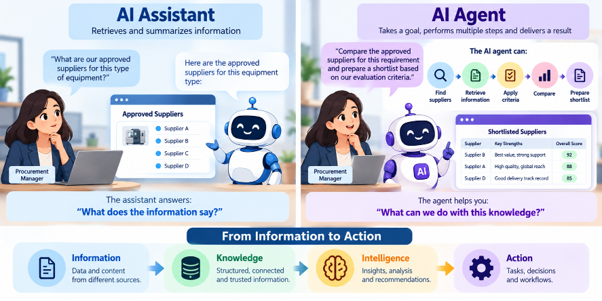
An AI assistant can help you find, understand and interact with information. On the other hand, an AI agent can potentially go further and use that knowledge to help complete a task.
Imagine a procurement manager asks:
“What are our approved suppliers for this type of equipment?”
An assistant can retrieve the relevant information.
Now imagine the request is:
“Compare the approved suppliers for this requirement and prepare a shortlist based on our evaluation criteria.”
That involves several steps:
Find suppliers → Retrieve information → Apply criteria → Compare → Prepare shortlist
If the AI agent has access to the appropriate systems, permissions and workflows, it can potentially perform parts of that process.
This changes the question from:
“What does the information say?”
to:
“What can we do with this knowledge?”
An agent therefore needs more than AI.
It needs:
Knowledge — to understand what it is working with.
Actions — to do something with that knowledge.
The progression becomes:
Information → Knowledge → Intelligence → Action
So, Where Do You Start?
This may sound like a huge transformation if an organization has thousands or hundreds of thousands of documents. It doesn’t have to be.
Don’t start with everything. Start with what matters most.
Look for content that is:
- Frequently used
- Business-critical
- Difficult to find
- Frequently updated
- Behind repeated questions
- Important to a particular workflow
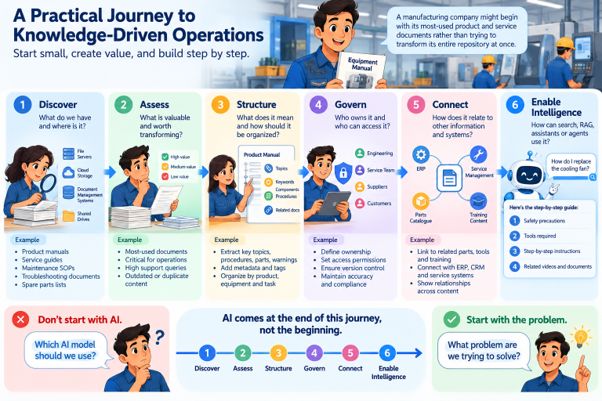
A manufacturing company, for example, might begin with its most-used product and service documents rather than trying to transform its entire repository at once.
A simple journey is:
- Discover — What do we have and where is it?
- Assess — What is valuable and worth transforming?
- Structure — What does it mean and how should it be organized?
- Govern — Who owns it and who can access it?
- Connect — How does it relate to other information and systems?
- Enable Intelligence — How can search, RAG, assistants or agents use it?
The important point is that AI comes at the end of this journey, not the beginning.
So instead of asking:
“Which AI model should we use?”
Start with:
“What problem are we trying to solve?”
- Maybe employees can’t find policies.
- Maybe researchers spend hours searching for sources.
- Maybe customers keep asking questions already answered in product documentation.
- Maybe learners struggle to navigate a large course library.
Start with the problem. Then build the knowledge foundation that can solve it.
And Don’t Forget the Human Side
Technology cannot answer every knowledge-management question.
Someone still needs to decide:
- Who owns the knowledge?
- Who can access it?
- Who approves changes?
- What happens when sources disagree?
- When should content be reviewed?
- When should a human check an AI-generated answer?
These questions become particularly important in areas involving finance, healthcare, legal information, safety or other regulated environments. AI can make information easier to find and use.
People still define what is trustworthy, who can use it and where human oversight is needed.
And that leads to one final question:
How do we know if it’s actually working?
Success isn’t simply launching an AI assistant.
It is seeing measurable improvements:
- Faster access to information
- Fewer repeated questions
- Less time spent searching
- Better discovery of research
- Easier learning
- Greater reuse of existing content
- Less manual processing
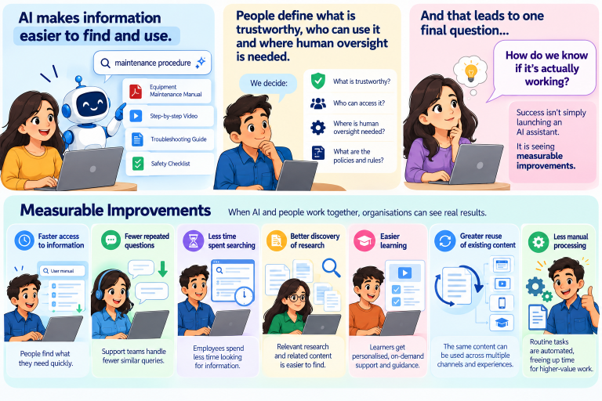
AI deployment is a technology milestone. Better access to knowledge is a business outcome.
This is where RioSmartech brings together the different pieces of the journey.
The content-to-knowledge journey isn’t simply an AI project. It brings together content, technology, learning, research, data and business processes.
RioSmartech’s capabilities span:
Publishing & Content
Creating, transforming, structuring and managing content.
Research & Intelligence
Making information easier to discover, connect, analyse and use.
Learning Solutions
Turning content into structured learning experiences, including AI-enabled learning.
Enterprise & Web Development
Building the platforms, applications and integrations through which knowledge is accessed and used.
AI, Agentic & Analytics
Connecting structured knowledge with RAG, AI assistants, agents, analytics and intelligent workflows.
This allows us to look at the whole content-to-knowledge journey, rather than treating content, technology and AI as separate projects.
The journey can look like:
Existing Content
↓
Structure & Transform
↓
Add Context & Relationships
↓
Govern & Connect
↓
Knowledge Solutions
↓
RAG / AI Assistants / Agents
↓
Better Decisions & Actions
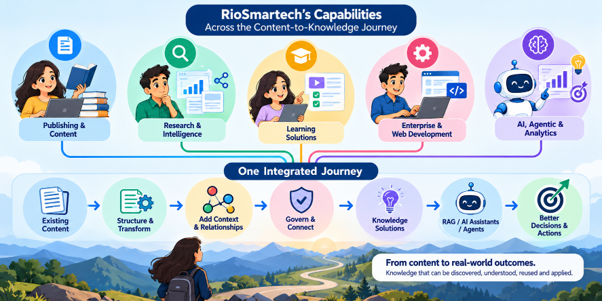
The starting point might be a publishing library, learning repository, research database, product documentation or enterprise information.
The destination is not simply a chatbot.
It is knowledge that can be discovered, understood, reused and applied.
The Shift from Content to Knowledge
For years, organizations have focused on creating more content, putting it into digital systems and making it available online.
The next step is different.
It’s about making that content understandable, connected, discoverable and usable.
The real opportunity with AI isn’t simply to generate more information. It is to make better use of the information organizations already have.
- A policy can become an answer.
- A research paper can become a connected source of insight.
- A product manual can become a support experience.
- A course library can become a conversational learning environment.
- And a collection of documents can become the foundation for intelligent assistants and agents.
The journey therefore isn’t:
Content → Chatbot
It is:
Content → Structure → Context → Knowledge → Intelligence → Action
AI may be changing how we interact with information.
But the quality of those interactions will depend on what sits underneath.
Smarter AI needs smarter knowledge.
Information is not knowledge. The only source of knowledge is experience.
— Albert Einstein